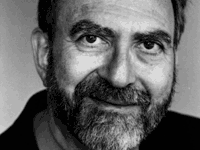
Morris Berman is this week's guest on Bob McChesney's Media Matters
by Live Streaming Program Begins at 11am Pacific Sunday Jul 30th, 2006 10:20 AM
Media Matters features host Bob McChesney in conversation with a variety of guests. Listeners may call with comments or questions.
Bob McChesney is a research professor in the Institute of Communications Research and the Graduate School of Information and Library Science at the University of Illinois at Urbana-Champaign.
“The media are central to all our lives,” he says. “Yet the media are the most frequently misunderstood parts of our lives. We want to help people understand the role of media in society.”
THIS WEEK'S GUEST ON ROBERT McCHESNEY'S MEDIA MATTERS
This week's guest is Morris Berman, the author most recently of "Dark Ages America: The Final Phase of Empire."He has taught at a number of universities in Europe and North America,and has held visiting endowed chairs at Incarnate Word College (San Antonio), the University of New Mexico, and Weber State University. Between 1982 and 1988 he was the Lansdowne Professor in the History of Science at the University of Victoria, British Columbia. Berman won theGovernor’s Writers Award for Washington State in 1990, and was the first recipient of the annual Rollo May Center Grant for Humanistic Studies in1992. He is the author of a trilogy on the evolution of human consciousness–The Reenchantment of the World (1981), Coming to Our Senses(1989), and Wandering God: A Study in Nomadic Spirituality (2000)–and in 2000 his Twilight of American Culture was named a “Notable Book” by the New York Times Book Review. Dr. Berman has done numerous radio and television interviews in Europe, the United States, and Asia, and in recent years has lectured in Australia, Colombia, Germany, Mexico, and New Zealand. Since 2003 he has been a Visiting Professor in Sociology at the Catholic University of America in Washington, D.C.
August 05, 2006


June 29, 2006
Letter to the New York Times
Washington, DC
30 June 2006
Dear Friends and Colleagues:
Some of you undoubtedly saw Michiko Kakutani’s virulent review of Dark Ages America in the June 16, 2006, issue of the New York Times. For those of you who have read DAA, you know her review was not merely a distortion of the book, but rather an outright lie–a fabricated version of what the book is about. Ms. Kakutani has a reputation for this sort of poison-pen-style demolition of serious authors, but I couldn’t help thinking that the great American tradition of red-baiting was at work here as well, as the references to Anne Coulter and Bill O’Reilly at the end of her review would suggest. In other words, she serves the Times’ purposes well: by savaging a left-wing study (and just to set the record straight, DAA has many things in it that conservatives would agree with), the Times can protect its flanks not only from the likes of Coulter and O’Reilly, but also from the Bush administration as well: "See? We attack the left; we’re not liberals at all! We’re ‘objective’."
Personally, I can’t help feeling that the NYT has fallen a great distance from the golden days of the Sulzberger family, and the once-admirable slogan of "All The News That’s Fit To Print." Beyond the embarrassing Jayson Blair affair, there is the matter of the newspaper fanning the flames for the 2003 invasion of Iraq by repeatedly publishing, on the front page, dubious unchecked stories regarding Iraq’s alleged WMD; and then, a year later (26 May 2004), admitting what it had done in a belated lukewarm apology to its readers–tucked away on p. 10 (on this see DAA, pp. 211 and 220). One has to wonder what in the world right-wing radio hosts are thinking when they rant against the Times as part of "the liberal media."
My own frustration, of course, is that of being smeared–for that is what Kakutani’s review amounted to–and then not being allowed the opportunity for a rebuttal. It is the NYT’s practice to phone writers of letters submitted to verify the authenticity of authorship. As it is now two weeks since I sent them an e-mail reply (below) to the review of my book, and I have received no such phone call, it would seem to be the case that the Times is content to "hit and run," so to speak. So the Kakutani version of the book becomes the "official" version in absence of a printed objection to it; it gets reprinted in the International Herald Tribune, which is sold in nearly every major city in the world, and is also translated into a number of foreign languages and reprinted in foreign newspapers. We do not, in this country, have the sort of censorship that obtained in the former USSR; rather, ours is much more subtle, and in the long run, probably much more effective. Bottom line: truly alternative voices cannot get heard here, and that is, to me, the saddest aspect of this whole thing.
Let me stop at that point. Hopefully, my letter of June 16 speaks for itself. In lieu of getting it published, I am posting it on my website (www.morrisberman.com) and ask that you send this message to anyone who you think may be interested in it. As follows:
To the Editor:
I am writing this in response to Michiko Kakutani’s savage review (16 June 2006) of my book Dark Ages America. The irony about her accusation that the book is a "rant" and that it contains no "carefully reasoned analysis" is that this description applies precisely to her review, rather than to my book. Ms. Kakutani never engages the text at the level of content; she never really tells the reader what is in the book, and therefore is spared the difficulty of critiquing it point by point. Indeed, she fails to contradict a single conclusion of the book with a fact or an argument. Chapter by chapter, in a carefully reasoned and heavily footnoted way, Dark Ages America discusses the repeal of the Bretton Woods Accords in 1971, and the consequent rise of finance capital; the development of the containment policy in the years following George Kennan’s formulation of it, and its subsequent impact on our foreign policy; the CIA-engineered overthrow of legitimate regimes (ably documented, for example, by New York Times reporter Stephen Kinzer), and the sewing of bitter resentment toward the United States in the Islamic world; Jimmy Carter’s unsuccessful attempt to address some of these entrenched patterns; the twentieth-century creation of a suburban landscape, and its role in American culture and politics; the economic challenge now being posed to us by China and the European Union–etc. None of this is addressed in a review that is little more than a disturbed emotional outburst, completely over the top. What recourse do I have in the face of such an utterly dishonest diatribe, except to urge the reader to check the text out for him- or herself?
My distress over this, however, goes beyond the personal to the sadness I feel for the country as a whole. What chance does the United States have if a carefully reasoned, empirically substantiated diagnostic look at how we got here gets completely blown out of the water by the nation’s premier representative of the Fourth Estate? A leading American historian wrote me, after reading Dark Ages America: "You have done this country a great service"; and a major German newspaper reviewed the book under the title, "Hopes of a Patriot." America’s major institutions, on the other hand, seem to be increasingly incapable of recognizing that incisive critics are the best friends this country has. By refusing to engage in actual dialogue over the issues raised in the book, and responding instead with a smear, the Times review is actually hastening the Dark Ages I describe in the text. The "sorrows of empire," as Chalmers Johnson puts it, are indeed upon us.
Sincerely,
Morris Berman
Washington, DC
16 June 2006
30 June 2006
Dear Friends and Colleagues:
Some of you undoubtedly saw Michiko Kakutani’s virulent review of Dark Ages America in the June 16, 2006, issue of the New York Times. For those of you who have read DAA, you know her review was not merely a distortion of the book, but rather an outright lie–a fabricated version of what the book is about. Ms. Kakutani has a reputation for this sort of poison-pen-style demolition of serious authors, but I couldn’t help thinking that the great American tradition of red-baiting was at work here as well, as the references to Anne Coulter and Bill O’Reilly at the end of her review would suggest. In other words, she serves the Times’ purposes well: by savaging a left-wing study (and just to set the record straight, DAA has many things in it that conservatives would agree with), the Times can protect its flanks not only from the likes of Coulter and O’Reilly, but also from the Bush administration as well: "See? We attack the left; we’re not liberals at all! We’re ‘objective’."
Personally, I can’t help feeling that the NYT has fallen a great distance from the golden days of the Sulzberger family, and the once-admirable slogan of "All The News That’s Fit To Print." Beyond the embarrassing Jayson Blair affair, there is the matter of the newspaper fanning the flames for the 2003 invasion of Iraq by repeatedly publishing, on the front page, dubious unchecked stories regarding Iraq’s alleged WMD; and then, a year later (26 May 2004), admitting what it had done in a belated lukewarm apology to its readers–tucked away on p. 10 (on this see DAA, pp. 211 and 220). One has to wonder what in the world right-wing radio hosts are thinking when they rant against the Times as part of "the liberal media."
My own frustration, of course, is that of being smeared–for that is what Kakutani’s review amounted to–and then not being allowed the opportunity for a rebuttal. It is the NYT’s practice to phone writers of letters submitted to verify the authenticity of authorship. As it is now two weeks since I sent them an e-mail reply (below) to the review of my book, and I have received no such phone call, it would seem to be the case that the Times is content to "hit and run," so to speak. So the Kakutani version of the book becomes the "official" version in absence of a printed objection to it; it gets reprinted in the International Herald Tribune, which is sold in nearly every major city in the world, and is also translated into a number of foreign languages and reprinted in foreign newspapers. We do not, in this country, have the sort of censorship that obtained in the former USSR; rather, ours is much more subtle, and in the long run, probably much more effective. Bottom line: truly alternative voices cannot get heard here, and that is, to me, the saddest aspect of this whole thing.
Let me stop at that point. Hopefully, my letter of June 16 speaks for itself. In lieu of getting it published, I am posting it on my website (www.morrisberman.com) and ask that you send this message to anyone who you think may be interested in it. As follows:
To the Editor:
I am writing this in response to Michiko Kakutani’s savage review (16 June 2006) of my book Dark Ages America. The irony about her accusation that the book is a "rant" and that it contains no "carefully reasoned analysis" is that this description applies precisely to her review, rather than to my book. Ms. Kakutani never engages the text at the level of content; she never really tells the reader what is in the book, and therefore is spared the difficulty of critiquing it point by point. Indeed, she fails to contradict a single conclusion of the book with a fact or an argument. Chapter by chapter, in a carefully reasoned and heavily footnoted way, Dark Ages America discusses the repeal of the Bretton Woods Accords in 1971, and the consequent rise of finance capital; the development of the containment policy in the years following George Kennan’s formulation of it, and its subsequent impact on our foreign policy; the CIA-engineered overthrow of legitimate regimes (ably documented, for example, by New York Times reporter Stephen Kinzer), and the sewing of bitter resentment toward the United States in the Islamic world; Jimmy Carter’s unsuccessful attempt to address some of these entrenched patterns; the twentieth-century creation of a suburban landscape, and its role in American culture and politics; the economic challenge now being posed to us by China and the European Union–etc. None of this is addressed in a review that is little more than a disturbed emotional outburst, completely over the top. What recourse do I have in the face of such an utterly dishonest diatribe, except to urge the reader to check the text out for him- or herself?
My distress over this, however, goes beyond the personal to the sadness I feel for the country as a whole. What chance does the United States have if a carefully reasoned, empirically substantiated diagnostic look at how we got here gets completely blown out of the water by the nation’s premier representative of the Fourth Estate? A leading American historian wrote me, after reading Dark Ages America: "You have done this country a great service"; and a major German newspaper reviewed the book under the title, "Hopes of a Patriot." America’s major institutions, on the other hand, seem to be increasingly incapable of recognizing that incisive critics are the best friends this country has. By refusing to engage in actual dialogue over the issues raised in the book, and responding instead with a smear, the Times review is actually hastening the Dark Ages I describe in the text. The "sorrows of empire," as Chalmers Johnson puts it, are indeed upon us.
Sincerely,
Morris Berman
Washington, DC
16 June 2006
May 29, 2006
Beacon blinking out: Dark view of America
Dark Ages America:
The Final Phase of Empire
By Morris Berman
W.W. Norton & Company. 416 pp. $25.95
Reviewed by Gresham Riley
From the Philadelphia Inquirer, 28 May 2006
To readers who already believe or suspect that the United States is in deep trouble at home and abroad, Morris Berman’s new book will come as no surprise.
To those who, like Ronald Reagan twenty years ago, continue to think of the U.S. as "a city on a hill whose beacon light guides freedom-loving people everywhere," it will most likely be dismissed as simply another exercise in knee-jerk anti-Americanism. Ironically, such a response will only hasten the outcome that Berman sees as inevitable: the end of the American empire and the dawn of a new "Dark Age."
Morris Berman is not another crackpot eschatologist. He is a serious and careful scholar who charts the final phase of a movement that began as 13 colonies, became transformed into a Republic, changed again into an empire, and now (like Rome at the time of Constantine’s death in A.D. 337) can only look forward to the sun’s setting on its period of world domination.
Berman believes that four characteristics of the West after the fall of Rome have reemerged in American society, and he uses these features to build his case for the book’s main thesis: the triumph of religion over reason; the atrophy of education and critical thinking; the integration of religion, the state, and the apparatus of torture; and the political and economic marginalization of our culture.
The critical turning point in our history, Professor Berman argues, was the transubstantiation of the American republic into an American global empire. Unlike bread and wine, this change was not a miracle but the result of deliberate choices by policy makers and support from the public. Two in particular, one in the foreign policy arena and the second having to do with monetary policy, loom large in Berman’s account.
Regarding foreign policy, common wisdom has it that the diplomat George Kennan was the architect of American Cold War strategy, the principle doctrine of which was the political--not military--containment of the Soviet Union as elaborated in his now famous "long telegram" and the "X" article in Foreign Affairs. Of much greater significance, in Berman’s view, was a subsequent top secret National Security Council document known as NSC-68 (1950), written by Paul Nitze and approved by his boss, Harry S. Truman. Basically, NSC-68 declared that "a defeat of free institutions anywhere is a defeat everywhere" and that, consequently, there was no such thing as "peripheral interests" with respect to American foreign policy. NSC-68 embodied an "Orwellian vision of world domination and permanent war" that guides our decision-making today.
The economic policy choice was the withdrawal by Richard M. Nixon in 1971 from the Bretton Woods Agreement (1944). As described by Berman, Bretton Woods "created a system of more or less fixed exchange rates among world currencies, and placed controls on international capital mobility." The objective was "to create a favorable environment for trade and investment while allowing countries to pursue full employment and social welfare policies." By withdrawing from the agreement, Nixon paved the way for American economic hegemony.
Berman explores these and other "policy roads" taken and not taken in a decidedly non-academic, informal style that is easily comprehensible to the intelligent lay reader. At the heart of his analysis is the idea that becoming an empire was the beginning of the end, because "the process of trying to maintain an empire would generate the resistance sufficient to undermine it."
Empire not only sets loose forces that eventually undercut it, but also corrodes the values, manners, indeed the very personhood, of its citizens. The emptiness and ignorance of the American public provide further evidence for Berman’s conclusion that there is no warding off the Dark Ages. Symbolic of the emptiness at the core of America is the replacement of values derived from the Western heritage and the Enlightenment by a MTV culture: unfettered individualism, consumerism, and hedonism.
As for basic knowledge, there is such a lack of it, Berman writes, "that one has to wonder if we are talking about ignorance or just outright stupidity"--adults who don’t know who our enemy was in World War II; who quiz their travel agents about whether it's cheaper to get to Hawaii by train or plane; who can’t locate the United States on a map; who can’t name the three branches of government; and who lack even an elementary understanding of thesis and proof, evidence and argumentation.
Although Dark Ages America breaks no new ground, Professor Berman assembles with uncommon clarity a vast amount of scholarship, data, and commentary in support of conclusions that most readers will resist. Unfortunately, this timely and important study will most likely be perceived as insufficiently scholarly by the "theory class" and as excessively gloomy by the "leisure class" to be taken seriously by either. Berman obviously anticipated some such reception. But, he explains, "there is value in the truth for its own sake, not just because it may possibly be put to some utilitarian or optimistic purpose."
Gresham Riley, President Emeritus of Colorado College and former president of the Pennsylvania Academy of the Fine Arts, lives in Philadelphia.
The Final Phase of Empire
By Morris Berman
W.W. Norton & Company. 416 pp. $25.95
Reviewed by Gresham Riley
From the Philadelphia Inquirer, 28 May 2006
To readers who already believe or suspect that the United States is in deep trouble at home and abroad, Morris Berman’s new book will come as no surprise.
To those who, like Ronald Reagan twenty years ago, continue to think of the U.S. as "a city on a hill whose beacon light guides freedom-loving people everywhere," it will most likely be dismissed as simply another exercise in knee-jerk anti-Americanism. Ironically, such a response will only hasten the outcome that Berman sees as inevitable: the end of the American empire and the dawn of a new "Dark Age."
Morris Berman is not another crackpot eschatologist. He is a serious and careful scholar who charts the final phase of a movement that began as 13 colonies, became transformed into a Republic, changed again into an empire, and now (like Rome at the time of Constantine’s death in A.D. 337) can only look forward to the sun’s setting on its period of world domination.
Berman believes that four characteristics of the West after the fall of Rome have reemerged in American society, and he uses these features to build his case for the book’s main thesis: the triumph of religion over reason; the atrophy of education and critical thinking; the integration of religion, the state, and the apparatus of torture; and the political and economic marginalization of our culture.
The critical turning point in our history, Professor Berman argues, was the transubstantiation of the American republic into an American global empire. Unlike bread and wine, this change was not a miracle but the result of deliberate choices by policy makers and support from the public. Two in particular, one in the foreign policy arena and the second having to do with monetary policy, loom large in Berman’s account.
Regarding foreign policy, common wisdom has it that the diplomat George Kennan was the architect of American Cold War strategy, the principle doctrine of which was the political--not military--containment of the Soviet Union as elaborated in his now famous "long telegram" and the "X" article in Foreign Affairs. Of much greater significance, in Berman’s view, was a subsequent top secret National Security Council document known as NSC-68 (1950), written by Paul Nitze and approved by his boss, Harry S. Truman. Basically, NSC-68 declared that "a defeat of free institutions anywhere is a defeat everywhere" and that, consequently, there was no such thing as "peripheral interests" with respect to American foreign policy. NSC-68 embodied an "Orwellian vision of world domination and permanent war" that guides our decision-making today.
The economic policy choice was the withdrawal by Richard M. Nixon in 1971 from the Bretton Woods Agreement (1944). As described by Berman, Bretton Woods "created a system of more or less fixed exchange rates among world currencies, and placed controls on international capital mobility." The objective was "to create a favorable environment for trade and investment while allowing countries to pursue full employment and social welfare policies." By withdrawing from the agreement, Nixon paved the way for American economic hegemony.
Berman explores these and other "policy roads" taken and not taken in a decidedly non-academic, informal style that is easily comprehensible to the intelligent lay reader. At the heart of his analysis is the idea that becoming an empire was the beginning of the end, because "the process of trying to maintain an empire would generate the resistance sufficient to undermine it."
Empire not only sets loose forces that eventually undercut it, but also corrodes the values, manners, indeed the very personhood, of its citizens. The emptiness and ignorance of the American public provide further evidence for Berman’s conclusion that there is no warding off the Dark Ages. Symbolic of the emptiness at the core of America is the replacement of values derived from the Western heritage and the Enlightenment by a MTV culture: unfettered individualism, consumerism, and hedonism.
As for basic knowledge, there is such a lack of it, Berman writes, "that one has to wonder if we are talking about ignorance or just outright stupidity"--adults who don’t know who our enemy was in World War II; who quiz their travel agents about whether it's cheaper to get to Hawaii by train or plane; who can’t locate the United States on a map; who can’t name the three branches of government; and who lack even an elementary understanding of thesis and proof, evidence and argumentation.
Although Dark Ages America breaks no new ground, Professor Berman assembles with uncommon clarity a vast amount of scholarship, data, and commentary in support of conclusions that most readers will resist. Unfortunately, this timely and important study will most likely be perceived as insufficiently scholarly by the "theory class" and as excessively gloomy by the "leisure class" to be taken seriously by either. Berman obviously anticipated some such reception. But, he explains, "there is value in the truth for its own sake, not just because it may possibly be put to some utilitarian or optimistic purpose."
Gresham Riley, President Emeritus of Colorado College and former president of the Pennsylvania Academy of the Fine Arts, lives in Philadelphia.
May 26, 2006
Interview with Boston Globe

A civilization running on empty
By Anna Mundow May 21, 2006
In ''The Twilight of American Culture" (2000), historian Morris Berman warned that voracious consumerism and corporate greed were corroding American culture and fostering anti-American sentiment. Now, in ''Dark Ages America: The Final Phase of Empire" (Norton), Berman argues that US policy abroad and the erosion of democracy and civic culture at home have brought the nation to the verge of collapse. He spoke from his home in Washington, D.C.
Q: How did we get here?
A: In the book I focus on the structural properties of how we got here because claiming that it's George W. Bush is a very superficial analysis. I do consider Bush a discontinuity with pre-9/11 days, but there's also continuity with our foreign policy since World War II. Joe McCarthy said that McCarthyism was Americanism with its sleeves rolled up. Well, Bush is essentially Wilsonianism or Trumanism with the sleeves rolled up. We feel that the world is at our disposal. And when other nations move to protect their resources, for example, we get enraged and interpret it as anti-Americanism.
Q: Wasn't this imperial role forced on the US?
A: By the late 1790s, virtue here was defined as success for yourself and your family in a competitive market. We are still reaping the effects of that. We undertook, after all, to annex half of Mexico in the middle of the 19th century. That was hardly foisted on us; it was part of Manifest Destiny and a religious vision. But the real imperial role gets going after 1945, with the development of the national security state. And from the time of Truman until the present -- with one exception, Jimmy Carter -- nobody could become president unless they indicated that they were going to serve and expand the national security state.
Q: Isn't the war on terror protecting the American way of life?
A: The real question is where 9/11 came out of. Americans have trouble getting their minds around the fact that what happened on 9/11 was reactive rather than offensive. We had been doing certain things to the Arab and Islamic worlds for decades, and finally they decided they weren't going to take it anymore. That does not mean that it's OK for 3,000 citizens to get slaughtered, of course not. But are we interested in how many of their citizens we slaughter? How could they do this when we're so good? George Bush said. Well, examine the possibility, as Jimmy Carter suggested, that we're not all that good.
Q: Is the US prepared for the next attack?
A: If you mean the attack we're going to launch against Iran, I think the government is going to prepare us by rerunning all the cliches. Regarding an attack on us, I myself cannot see how the detonation of a nuclear device in some American city will not occur within the next decade. We might catch it in time, but . . . maybe not.
Q: What are our choices?
A: That we will not decline is not a option because it's built into the structure of how we live. We've really sealed our fate. At the end of the book I say that there are two possible paths: One is that we decline rapidly; the other is that we decline gradually. And you can have gradual decline if you exercise some intelligence as to your impact on other people, but that requires something that has historically never been our strong suit: empathy.
Q: Where will the US be internationally by, say, 2030?
A: We're riding various bubbles. One bubble is the belief that George Bush is protecting us from terrorism. Another is the illusion of economic well-being. By 2030, maybe a bit later, we'll be pretty much a second-rate power in the world. Remember that the shift in perception toward the British Empire only came with the [1956] Suez crisis. Well, we're heading for our very own Suez. How long before OPEC switches from dollars to euros, and a devaluation of at least 25 percent of the dollar results? How long before China, Japan, and the [European Union] stop floating enormous loans to us to support a wasteful consumer lifestyle? I mean, does everybody really need all this stuff?
Q: You don't think much of Christian fundamentalism?
A: Oh, it's a wonderful thing. Clearly it's the right path: flexible, engaged, empirical . . .
Q: You don't think much of Islam?
A: There are many Islamic scholars who agree that at some point it became frozen intellectually. Within Islam, as within Christian fundamentalism, you can't voice a criticism without generating an angry reaction.
Q: Aren't you advocating a form of fundamentalism yourself, a return to a pre-industrial age? A:Even if I thought that would be wonderful, it's not going to happen. The only way we will pull back is when the system crashes, something I do think is in the cards. And although I have a lot of problems with Martin Heidegger because of his association with Nazism, I think he was right when, referring to the role of technology and consumerism in our lives, he remarked, ''Only a god can save us now." There are, in other words, fundamental values we lost along the way.
Q: Do you feel at home in America?
A: A lot of the time I don't. What have we become, finally? A civilization dedicated to turning everything into a market. It's an empty vision, it seems to me, and that makes me sad. Surely the Founding Fathers had something better in mind, right?
Anna Mundow, a freelance journalist living in Central Massachusetts, is a correspondent for the Irish Times. She can be reached via e-mail at ama1668@hotmail.com.
© Copyright 2006 The New York Times Company
May 13, 2006
The Leon Charney Report
 Morris Berman Featured on The Leon Charney Report
04/30/06
Watch with:
 Real Media
 Windows Media Player
Dark Days for America?
 The Leonard Lopate Show
Tuesday, April 18, 2006
Airs weekdays at 12PM on 93.9 FM and AM 820 and Tuesdays through Saturdays at 3AM on AM 820
 Listen to the whole show
Cultural historian Morris Berman explains why he thinks modern-day America is medieval. And Time columnist Joe Klein tells us what he thinks is wrong with American politics today. Plus, some poetry from a self-confessed sinner. And Sebastian Junger shares his true-crime take on the Boston Strangler.
Host Leonard Lopate lets you in on the best conversations with writers, actors, ex-presidents, dancers, scientists, comedians, historians, grammarians, curators, filmmakers, and do-it-yourself experts. Live interaction is critical to Lopate's conversational and personal style. "I think it's crucial to maintain eye contact when you're discussing complex matters with the likes of John Updike, Doris Lessing, Bill Bradley, Mark Morris, and Francis Ford Coppola, all of whom are return guests to Leonard Lopate on WNYC, " says Lopate.
Subscribe to:
Posts (Atom)